 Expressnews

Chennai, January 2026:
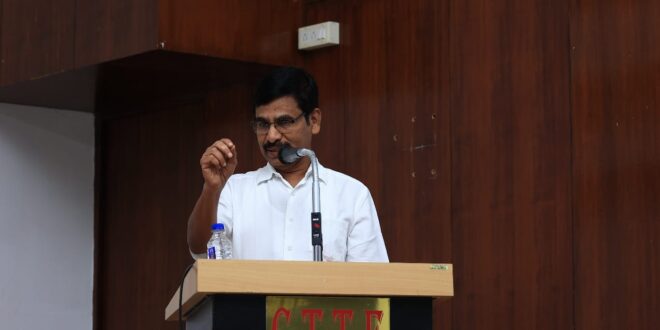
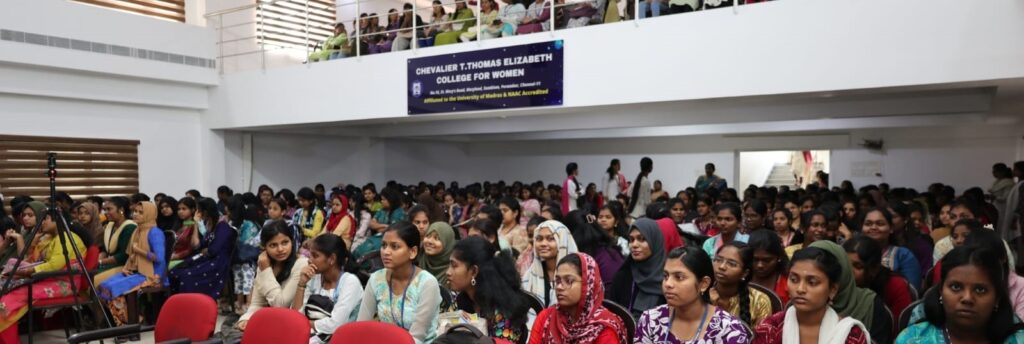
At a time when digital distraction increasingly competes with sustained reading, Dr V. Iraianbu, IAS (Retd.), offered a compelling defence of books, self-reflection and intellectual discipline in a lecture delivered as part of the Chennai International Book Fair (CIBF) 2026. Speaking at Chevalier T. Thomas Elizabeth College for Women, Perambur, Dr. Iraianbu addressed students on the theme “Let Us Read Ourselves,” blending Tamil linguistic philosophy with insights drawn from world literature.
Delivered in rhythmic Tamil marked by a measured cadence, alliteration and clarity of structure, the lecture demonstrated how language itself can become a tool for thought. Dr Iraianbu began by classifying different types of readers using Tamil vowel sounds as an organising framework, linking phonetics with human qualities and ethical dispositions. Reading, he suggested, is not a mechanical activity but a formative practice that shapes character, judgement and social responsibility.
To illustrate this, he drew on examples from world intellectual history. Karl Marx, he noted, virtually lived in libraries, meticulously compiling notes that would eventually shape Das Kapital. Charles Darwin, too, read extensively for over two decades before publishing The Origin of Species. Such sustained engagement with texts, Dr. Iraianbu argued, was central to their lasting contributions to social justice and scientific understanding.
He contrasted purposeful reading with reading driven by greed, referring to Christopher Marlowe’s The Jew of Malta and its later reworking in William Shakespeare’s The Merchant of Venice. Through vivid narration, he showed how literature reflects moral choices and inner conflicts, making characters from classical texts resonate with contemporary concerns.
The second part of the lecture focused on what Dr. Iraianbu termed five “padi” (steps) for living well. Playing on the word padi as both “steps” and “levels,” and drawing on the musical possibilities of Tamil in a manner reminiscent of lyricists such as Kannadasan, he outlined principles aimed at helping young people rise in life. The approach combined ethical reflection with linguistic elegance, making abstract ideas accessible to a student audience.
In the concluding segment, Dr. Iraianbu turned to the importance of self-knowledge, which he described as the foundation of leadership. He observed that individuals often remain unaware of their darker sides, and that this lack of self-awareness can generate inner conflict and impede growth. True reading, he argued, must therefore include reading oneself.
Elaborating on how to read, he introduced the triad “yaasithu, nesithu, yosithu”—to seek, to value and to reflect—underscoring critical thinking as an essential skill for the present generation. Students, he urged, should never allow a day to pass without reading and should learn to live with books rather than approach them merely out of compulsion.
The lecture, widely seen as particularly relevant for contemporary students, emphasised the need to retain a living relationship with books even in an age of rapid information flow. It was organised by Chevalier T. Thomas Elizabeth College for Women as part of its engagement with CIBF 2026 and coordinated by Dr. M. Kavitha, Chennai District Library Officer.